Keynote: AI for SMEs
Artificial intelligence in mid-sized companies: from hype to business value
Where does AI really pay off? What should we do now? And how do we take action with limited resources?
Many mid-sized companies are asking how they can use AI sensibly, raise productivity and secure their competitiveness. For SMEs, the path there looks different from that of a large corporation. Prof. Stummeyer shows where AI can create concrete value today and how SMEs can move pragmatically from experimenting to implementing.
Well-founded. Clear. Practical. And with live applications that show what is already possible today.
- 600+Keynotes & talks since 2016
- Top 100Excellent European Speakers (Handelsblatt)
- CSPCertified Speaking Professional
- 4.95 / 5 751 reviews on ProvenExpert
When this keynote is the right choice
AI has long been on the agenda. But where do you sensibly start?
Perhaps some of these situations sound familiar.
“Our people have been using ChatGPT for ages – but everyone in their own way.”
Some experiment, others reject AI altogether. Shared rules, standards and a clear understanding are missing.
“We know we have to engage with AI. But with what, exactly?”
There are countless tools and possibilities – but no clear priority for your own company yet.
“We don’t have the resources of a large corporation.”
In-house IT and digital teams are stretched. Time, people and budgets for transformation programmes lasting years are simply not there.
“We see plenty of impressive applications – but where is our business case?”
A great deal is technically possible by now. What will count is what delivers measurable value in your own organisation.
“Management wants to lead the way – but not everyone is on board.”
Alongside enthusiasm there is uncertainty, scepticism and sometimes concern about people’s own jobs.
“We don’t want to fall behind – but we don’t want to chase every hype either.”
For mid-sized companies in particular, the crucial question is which developments matter and where waiting is the wiser choice.
This is exactly where the keynote comes in. It provides orientation, makes concrete applications visible and translates technological developments into one question:
Which of this is relevant for our company?
Is this keynote right for our event?
Looking to book the speaker? For occasions, formats, fees and availability, simply get in touch directly.
AI in the German Mittelstand
The question is no longer whether AI will reach mid-sized companies
In the German Mittelstand, too, AI is increasingly becoming part of everyday business.
20%
of mid-sized companies in Germany use at least one AI technology — almost 780,000 businesses.
5 ×
as high as six years earlier. Between 2016 and 2018 the share was just four per cent.
36%
among companies with more than 50 employees — up from six per cent in the same comparison period.
KfW Research, Fokus Volkswirtschaft No. 554 of 29 July 2026 and press release of 11 February 2026. The data are based on the KfW SME Panel 2025, an annual representative survey of mid-sized companies in Germany; the periods 2022–2024 and 2016–2018 are compared.
Currently the most widespread are applications that can be integrated into everyday work quickly and with comparatively little effort: natural language generation (14 per cent) and text recognition (10 per cent). More demanding applications such as data analytics (3 per cent) are still considerably rarer.
This shows where mid-sized companies start: wherever technology delivers concrete value without restructuring.
And that is precisely where the next challenge arises. Trying things out is no longer enough. The decisive question now is:
How do individual AI experiments become productive use across the company?
The economic question
Does AI actually pay off for mid-sized companies?
The first robust answers are now available. A study by KfW Research has, for the first time, measured the link between AI use and business performance in mid-sized companies on the basis of the SME Panel — taking other important influencing factors into account.
+1.1
percentage points stronger revenue growth at AI-using companies compared with similar companies without AI.
+0.9
percentage points higher return on sales in the same comparison.
+3.4%
higher labour productivity, equivalent to around €7,600 per full-time employee.
KfW Research, Fokus Volkswirtschaft No. 558 of 15 September 2026, based on the KfW SME Panel, survey period 2022–2024.
This does not mean that AI automatically makes companies more successful. The study expressly states that, from a scientific point of view, it remains unclear whether the link is causally due to the use of AI — or whether more successful companies are generally more likely to introduce AI. It also notes that positive effects often only appear with a delay.
But it does provide an important pointer: AI is increasingly becoming a competitive factor. The decisive factor is selection: finding the right applications and integrating them cleanly into operations.
Why mid-sized companies need different answers
What works for a large corporation is far from guaranteed to be right for a mid-sized company
An international corporation can build its own AI teams, launch dozens of pilots in parallel and commit multi-million budgets to technology projects. Reality in the Mittelstand looks different.
The starting point
- IT departments are smaller.
- Skilled staff are scarce.
- Day-to-day business comes first.
- Investments have to pay off.
- Often there is simply no capacity for innovation programmes lasting years.
And this is exactly where a strength can lie
- shorter decision-making paths,
- greater closeness to customers and employees,
- deep process and industry knowledge
- and a strong culture of getting things done.
Mid-sized companies therefore need their own pragmatic path to AI — one that starts with the applications that make a difference.
From hype to business value
Five tasks mid-sized companies are facing now
Understand
What can AI really do today?
Amid headlines, new models and an endless stream of new tools, it is becoming ever harder to tell substance from hype. The first step is therefore orientation.
- What works reliably today?
- What is relevant for use in the business?
- Which developments should a company keep an eye on?
Focus
Where does AI create the greatest value for us?
Not every technically interesting project makes economic sense. Companies therefore need to ask systematically:
- Where do we lose a lot of time today?
- Where are we short of skilled staff?
- Where do repetitive tasks arise?
- Where is important knowledge locked in people’s heads or in documents?
- Where could we become faster or better for our customers?
That is where interesting AI use cases begin.
Enable
How do we turn employees into good AI users?
Productivity gains do not come from a company simply giving its employees an AI tool. People need to learn
- to delegate tasks to AI sensibly,
- to give good instructions,
- to check results critically
- and to recognise when human expertise remains indispensable.
AI literacy is becoming a core work skill.
Set rules
Which guardrails do we need?
Mid-sized companies don’t need hundred-page rulebooks. But they do need clear, understandable ground rules.
- Which data may be entered into an AI system?
- Which tools are approved?
- Who checks results, and when is human oversight required?
- How do we handle data protection, copyright and confidential company knowledge?
Implement
How do we get from experiment to process?
A ChatGPT account is not yet an AI transformation. What matters is whether successful applications find their way into day-to-day work. That means:
- Changing processes.
- Integrating tools.
- Clarifying responsibilities.
- Measuring experience.
- And scaling what works.
In the end, what counts is the next sensible step.
AI that can pay off
Where artificial intelligence can make a concrete difference in mid-sized companies
The most exciting applications don’t have to be futuristic. Value often arises precisely where employees today spend a lot of time on information, documents, communication and routine tasks.
Sales
Reaching customers faster
Preparing customer meetings, summarising information, structuring call notes, drafting quotes and creating personalised communication. AI can relieve sales staff of groundwork – leaving more time for the actual conversation with the customer.
Marketing
More content with modest resources
Developing copy, creating campaign variants, generating images, preparing presentations and tailoring content to target groups. Small marketing teams in particular can work much faster as a result.
Customer service
Making knowledge available faster
Pre-sorting enquiries, drafting replies, searching documentation and handling recurring questions. AI can help make knowledge available where it is needed.
Administration
Reducing routine work
Analysing documents, extracting information, summarising meetings, preparing correspondence or automating workflows. The most rewarding use cases often lie in everyday office work that already exists.
Production & engineering
Supporting people with data and knowledge
From quality control and maintenance to technical documentation and the analysis of production data, interesting AI applications are increasingly emerging in manufacturing and engineering too.
Knowledge work
From blank page to first draft
Researching, structuring, analysing, comparing, developing concepts and preparing the basis for decisions. AI is increasingly becoming an assistant for skilled knowledge work.
This shifts the question — away from what the technology can do and towards your own organisation: Where does AI pay off for us?
What the audience experiences
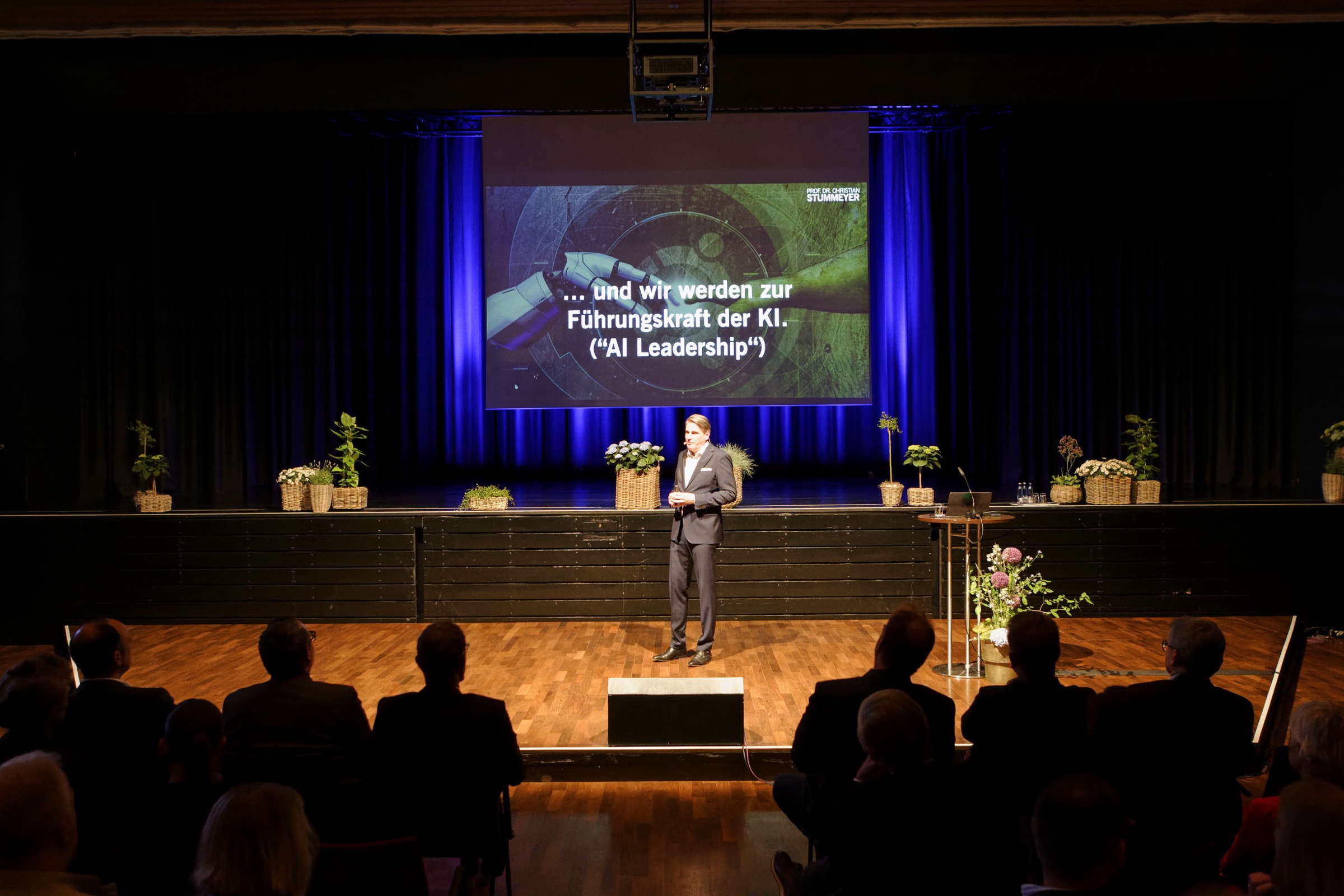
AI that works alongside him on stage
Prof. Stummeyer demonstrates the possibilities of artificial intelligence live. The audience sees how a few instructions produce texts, generate images, process information or build applications. And the examples reflect the audience’s own reality: a sensible AI use case looks different for a trade business than for a bank, and different for a machine builder than for a retailer.

Roofing trade and building materials
COBA-Dach-Forum, Hanover
360 roofing firms and building materials dealers
For the network of roofing specialists of COBA Baustoffgesellschaft, the slide deck was created specifically for the roofing industry. On screen, the AI wrote a live job advert for a roofer, aimed at Generation Z. Sven Plöger and Reiner Calmund appeared on the same stage.
Regional business
MEKOM Unternehmertag (business day), Osterode am Harz
200 business owners and entrepreneurs
Trades, retail, industry and services from the former district of Osterode in one hall. One example was a job advert for a civil engineer at a construction company from Göttingen. To close, an AI-written song about the Stadthalle Osterode was played.

Cross-border business
Bavarian-Czech Business Day, Deggendorf
800 entrepreneurs from two countries
Keynote in German, slides in English, with simultaneous interpretation into Czech. The prompt example came from the region: advertising copy for the click-fit oak parquet of a Bavarian timber merchant. To finish, a bilingual AI song about Deggendorf.

Furniture and kitchen retail
SHD Forum, Sayner Hütte
more than 200 participants from retail and industry
In front of manufacturers, retailers and service providers from the furniture and kitchen industry, an advertising visual for a kitchen studio was created — next to the same attempt from October 2022. The difference makes visible the pace that is otherwise only talked about. The trade magazine MÖBELMARKT reported on it afterwards.
Local government and regional business
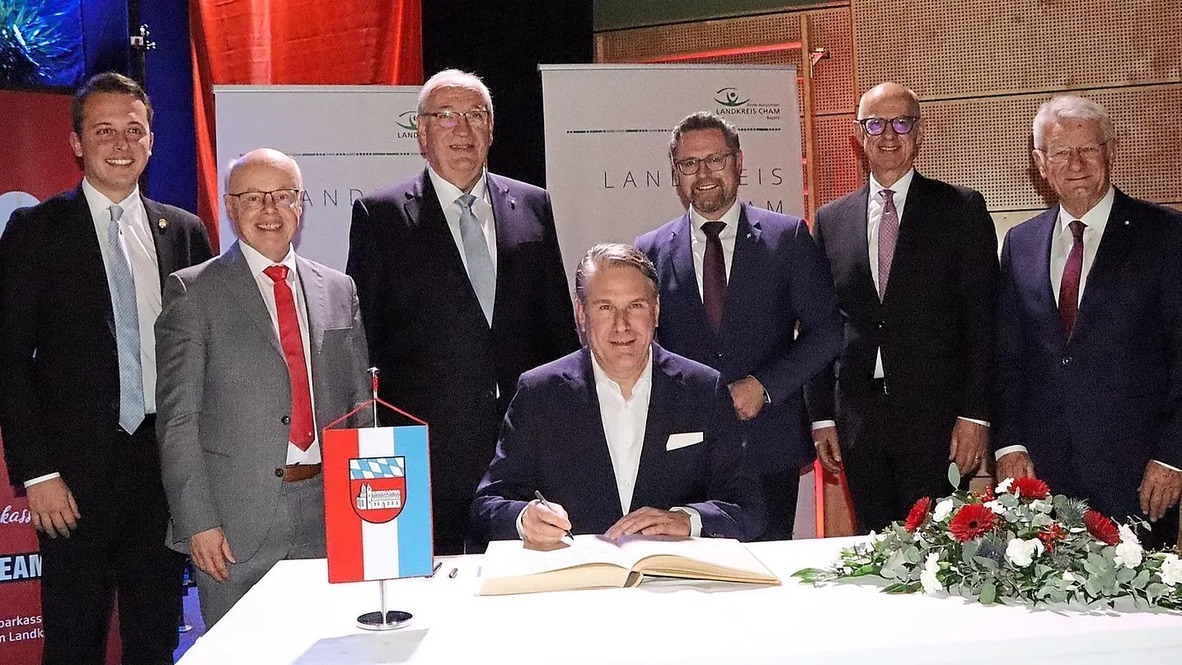
Annual Reception of the District of Cham, Waldmünchen
600 guests, streamed live
In front of guests from business, politics, society and the voluntary sector. The example came from the administration of a construction company in Cham, together with the question of what AI means for public services and infrastructure. Afterwards came the signing of the district’s guest book.
This is precisely how transfer happens. In the minds of the audience, “That’s impressive” becomes: “Where could we use this ourselves?”
Why implementation is often harder than technology
What is holding mid-sized companies back?
Technology is only part of the challenge. In many companies, quite different factors act as a brake.
Companies are therefore rarely short of applications. They are short of orientation.
KfW Research reaches the same conclusion: identifying the first practical AI applications is a central hurdle — and low-threshold information services are used more effectively than more complex routes.
KfW Research, Fokus Volkswirtschaft No. 554 of 29 July 2026.
Mid-sized companies don’t have to be able to do everything
But they do need to know what counts for them
KfW Research shows that company size matters less for AI adoption than a company’s level of digitalisation, its existing digital know-how and its general capacity for innovation.
What makes the difference is a digital foundation, in-house expertise and a willingness to change established ways of working — a dedicated data science team is not part of it.
Every company can start where it stands. All that needs clarifying is the next step.
KfW Research, Fokus Volkswirtschaft No. 554 of 29 July 2026.
More than a talk about technology
What this keynote can do for your company
A keynote does not implement an AI strategy. But it can create something that is essential before any change: a shared understanding of what it is really all about.
Orientation
Managers and employees can better assess where AI stands today and which developments are relevant for mid-sized companies.
Prioritisation
The audience learns to distinguish between impressive technology and sensible use cases.
Practical relevance
Concrete examples show how AI can be used in typical functions of a mid-sized company.
A shared language
Management, leaders and employees gain a common starting point for further discussion.
Realism
Alongside the opportunities, limits, errors, data protection and responsibility are a natural part of the keynote.
Activation
Participants experience AI live and start thinking through applications for their own working environment.
What participants take away
After the keynote, participants should be better able to judge
- what AI can actually do today,
- where sensible applications in their own company might lie,
- why not every AI project has a business case,
- what role employees and leaders play,
- which guardrails are necessary,
- and what a pragmatic start can look like.
Above all, though, they should leave the room with a different question. Not: “What else can ChatGPT do?” But: “What exactly should we be doing with it now?”
For your event
A relevant topic. Clearly told. Professionally brought to the stage.
For organisers, what matters most is whether a topic works in the room. The keynote therefore combines:
Relevance
A topic that is on the minds of business owners, leaders and employees right now.
Clarity
Accessible insight for a business-minded audience.
Practical focus
Examples drawn from real business life.
Live experience
AI visibly takes shape on screen during the keynote.
Humour and storytelling
A complex topic is conveyed in an entertaining way without losing substance.
Customisation
Industry, event and audience are woven into the examples and live applications.
Why Prof. Dr. Christian Stummeyer
Seen the corporation. Lived the Mittelstand. Researched AI.
When it comes to mid-sized companies, what counts is whether someone understands how businesses really work. Christian Stummeyer combines perspectives that rarely come together in one person.
Strategy consultant
As a consultant at the Boston Consulting Group, he worked on strategy and transformation.
Corporate manager
In the senior management circle of Siemens AG, he came to know the reality of a global technology group.
Entrepreneur
As a three-time entrepreneur, he knows the other side first-hand: limited resources, operational responsibility and the need to make decisions that make economic sense.
Professor & AI researcher
Today Christian Stummeyer is Professor of Business Informatics and Digital Commerce at Technische Hochschule Ingolstadt and Scientific Director of the Bavarian AI centre AININ.
Professional speaker
Since 2023 he has held the international Certified Speaking Professional (CSP) designation of the National Speakers Association.
More than 600 keynotes since 2016 and 4.95 out of 5 points from 751 independent reviews document the satisfaction of his clients and audiences.
Academic substance. Entrepreneurial practice. Professional stage presence.
Watch first. Then decide.
See Prof. Stummeyer on stage for yourself
Keynote trailer
A complete AI keynote
What audiences say
What participants take away from the keynotes
Clarity
The talk was very engaging, well and vividly explained, easy to understand even for listeners with no AI experience, very insightful and humorous too. Not a second was boring. It dispelled any fears of AI people may have had.
Practical relevance
A highly interesting talk that “got across” the benefits of AI for SMEs very vividly.
Activation
It was simply a talk that left you wiser. Not just well done – I actually took something away and started 2–3 concrete actions. Time well invested.
Stage presence
Prof. Dr. Stummeyer presented in a very refreshing and, above all, practical way. A very professional presentation. Many thanks for that.
4.95 out of 5 from 751 independent reviews on ProvenExpert. See all reviews
A selection of past clients
Booked by mid-sized companies, associations and leading businesses


Which occasions?
Particularly suited to events where AI should turn into orientation
Content, examples and tone are tailored to the occasion, industry and audience. All topics and dates at a glance: AI Keynote Speaker and Dates & Events.
Frequently asked questions
What organisers want to know before booking
Which companies is the keynote suitable for?
The keynote is aimed especially at owners, managing directors, leaders and employees of mid-sized companies who want to understand how AI can be used sensibly in their business. It makes no difference whether the company is just starting out or already uses its first AI applications.
Is the keynote also relevant for smaller companies?
Yes. Smaller companies in particular benefit from concentrating on a few sensible applications. Many of the AI tools available today can be used without an in-house development department.
Do participants need prior experience with AI?
No. Prof. Stummeyer meets participants wherever they are. AI newcomers grasp the fundamentals and possibilities, while more experienced users gain new applications, context and ideas for taking their use further.
Is the keynote technical?
No. Technology is explained where it is needed for understanding. The focus is on the questions: What does AI mean for companies? Where is the value? What is changing? And what should we do now?
Which AI applications does Prof. Stummeyer show?
Depending on the occasion, these can include applications from generative AI, text and image generation, knowledge work, automation, AI agents and vibe coding. The examples are updated regularly because the technology is evolving very quickly.
Is the keynote tailored to our industry?
Yes. The industry, occasion, audience and objectives of the event all feed into the preparation. This makes it possible to use examples that are closer to the audience’s everyday reality.
Does the keynote also cover risks and data protection?
Yes. Hallucinations, data protection, company knowledge, deepfakes, responsibility and governance are as much a part of the keynote as opportunities and applications.
Does Prof. Stummeyer also address the EU AI Act?
Yes, where it suits the occasion and audience. This is not legal advice, but an overview of which organisational and business questions gain additional importance through the regulatory framework.
Can the keynote replace an AI strategy?
No. Nor is it meant to. A keynote creates orientation, shared understanding and fresh impetus. It can therefore be a good starting point for engaging further with AI – the concrete implementation then has to happen within the company.
How long is the keynote?
Typically 40 to 60 minutes, usually followed by a Q&A session. The keynote can be integrated into different time formats; content and dramaturgy are adapted to the available slot.
Which events is the keynote suitable for?
For business days and SME congresses, leadership conferences, strategy and management meetings, customer events, association and chamber of commerce events, bank and savings bank events for business clients, kick-offs, employee events, and transformation and digitalisation days.
AI for SMEs
Your company doesn’t have to do everything with AI. But it should know what pays off.
Artificial intelligence offers mid-sized companies enormous opportunities. The challenge lies in the selection: finding the right applications, bringing employees along and turning technology into concrete business value. A keynote by Prof. Dr. Christian Stummeyer creates a shared starting point for this. Three details are all it takes: whom you have invited, where your audience stands on AI and what you want to achieve. From these, you receive a concrete proposal for tailoring the keynote to your occasion – with format, key topics and, where appropriate, live demos for your industry.
Check dates and availability