AI Keynote Speaker
The Megatrend Generative AI
Understand what’s coming. Recognise what matters. Take action.
Generative AI has arrived in everyday work. Now the more demanding phase begins: companies have to decide where AI creates real value, how people can work with it sensibly — and which rules apply. Prof. Dr. Christian Stummeyer brings the possibilities to life on stage and translates the development into the decisive question: what does this mean for us, and what should we do now?
- 600+Keynotes & talks since 2016
- Top 100Excellent European Speakers (Handelsblatt)
- CSPCertified Speaking Professional
- 4.95 / 5 751 reviews on ProvenExpert
When this keynote is the right choice
AI is on everyone’s agenda. But is it clear what it means for your organisation?
Most companies have long been engaging with artificial intelligence. Yet there is a big step between first experiences with ChatGPT and productive, responsible use. The keynote is a particularly good fit when …
- Your people are already using AI, but a shared understanding and clear direction are missing.
- Your leaders need to judge what generative AI really means for the business model, processes and the way work gets done.
- Enthusiasm, uncertainty and scepticism exist side by side in your organisation.
- Isolated experiments and tools are meant to turn into a systematic approach to AI.
- A strategy, leadership or transformation event needs a powerful shared impulse.
- Your event should take up a topic of the future that is relevant, surprising and keeps people talking afterwards.
In short: if AI in your company is to move from a talking point to something you actively shape, this keynote creates a shared starting point.
What the audience experiences
What is taking shape on the screen right now
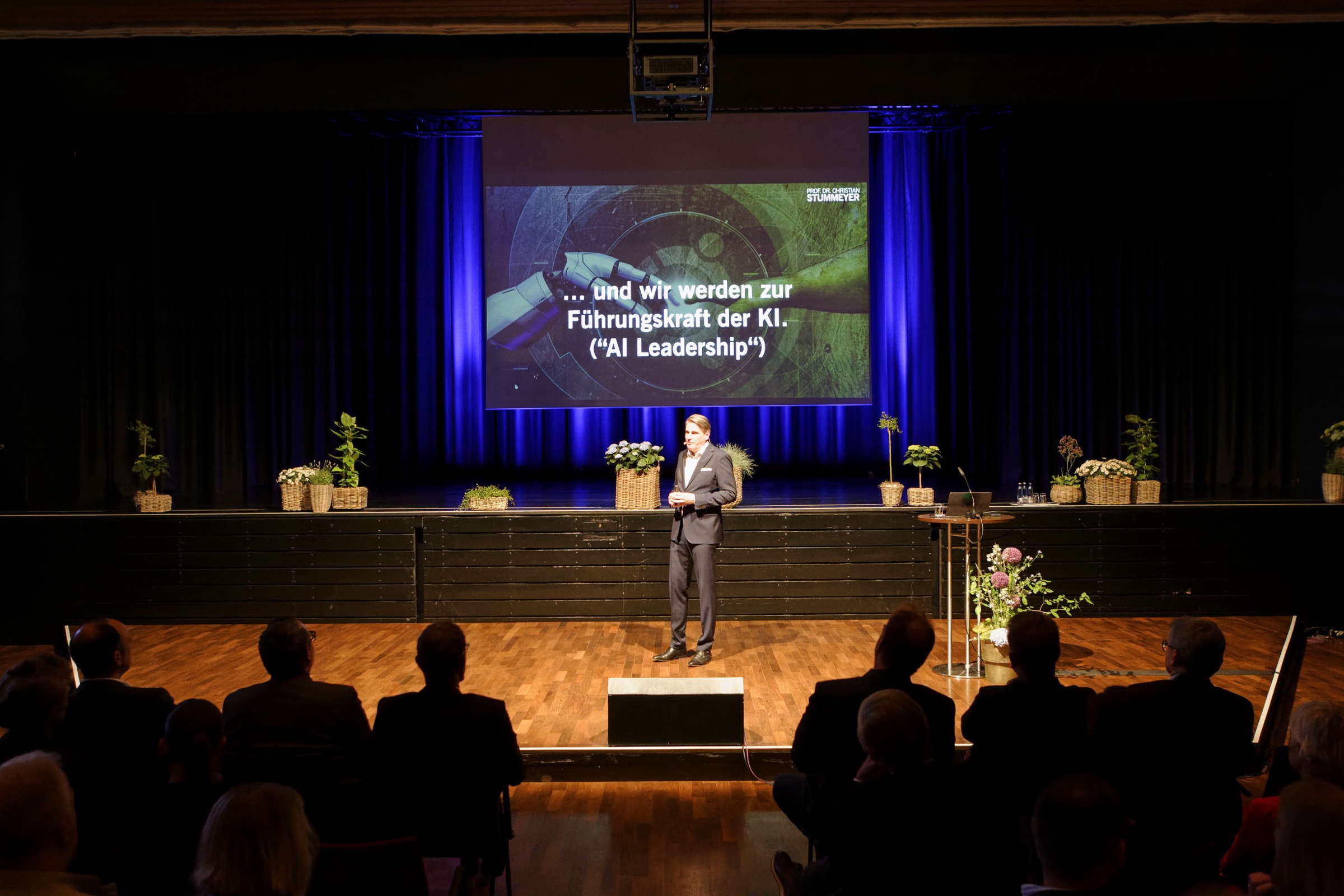
Most of the keynote consists of live demonstrations. All the images here were taken at keynotes he has delivered.

Text
Five building blocks — and the job advert is written
Role, task, target group, tone and format: from just a few inputs, a complete text takes shape on the screen. The application is tailored to the audience: for an orthopaedic practice it looks different than for a roofing firm, a bank or an industrial group.
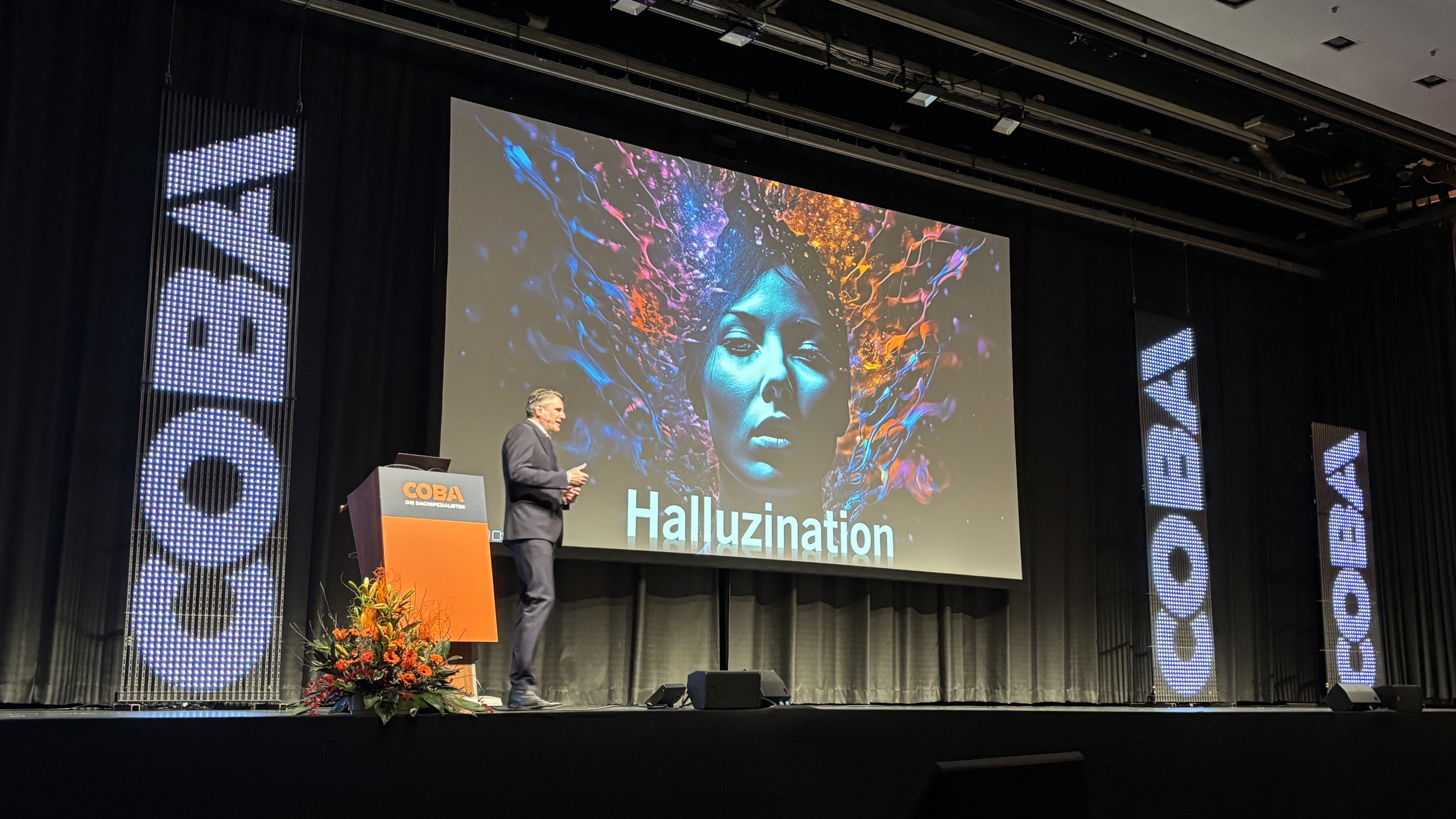
Image and video
Photorealistic — and that is exactly why it matters
A professional advertising visual is created in seconds, then it starts to move. What a few years ago would have needed a production company, a shooting day and a budget now happens on demand. And this is precisely where the perspective shifts: if content like this can be generated — how will we tell in future what is real?
AI agents
AI no longer just answers. It gets things done.
The next generation does not wait for every single instruction. Agentic systems break assignments down into steps, use tools and handle tasks increasingly on their own. And that changes our role too: the user of a tool becomes the manager of digital assistants.

Vibe coding
Say what the software should do — and it appears
Building websites, developing small applications, automating workflows: more and more often, natural language is all it takes to create working software. AI is changing knowledge work — and at the same time lowering the barrier to developing digital solutions at all.
Digital twin
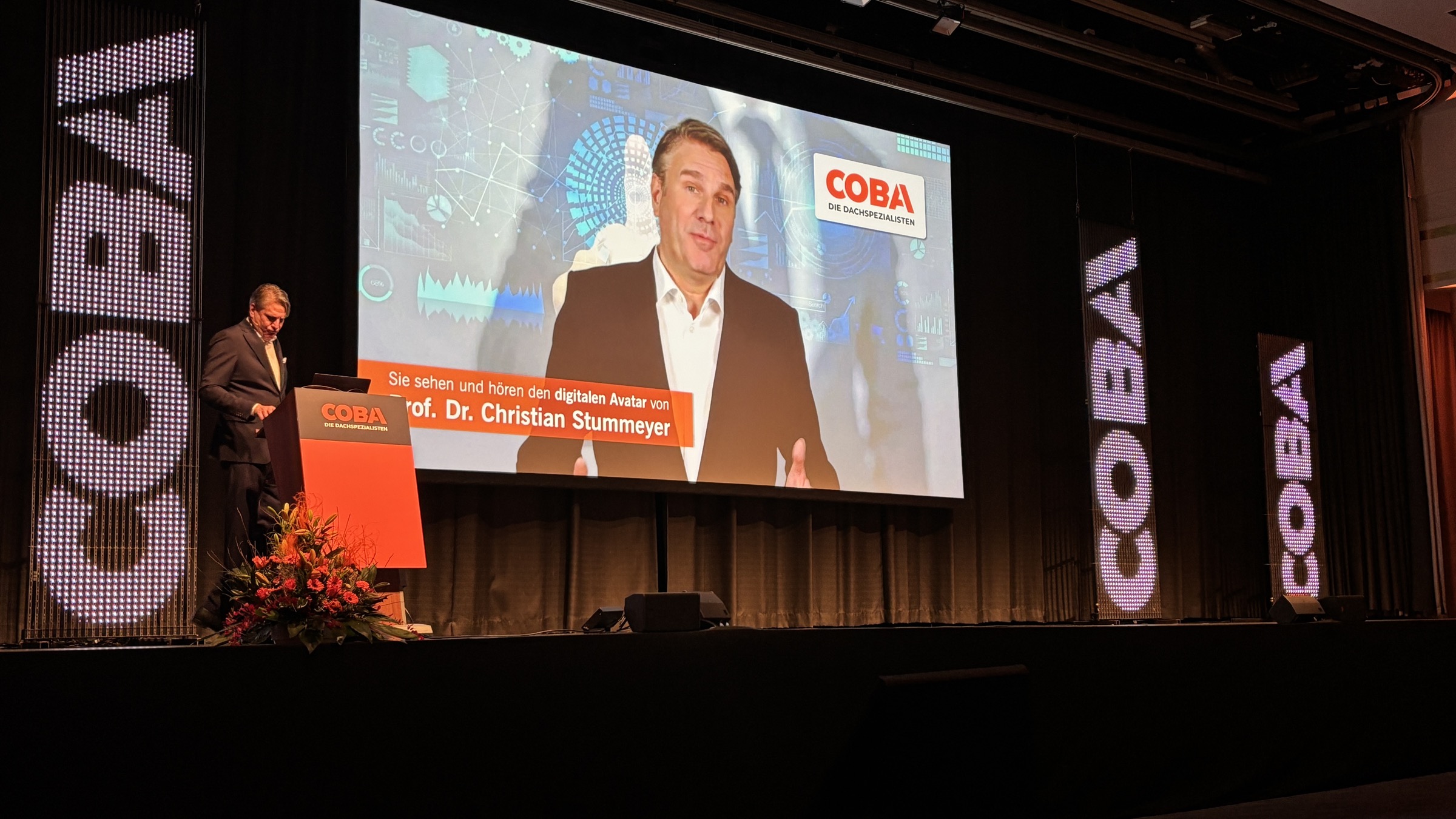
Suddenly Prof. Stummeyer is speaking — while standing right next to it
On the screen, a digital avatar delivers part of the keynote. With his face, with his voice, while the original stands beside it in silence. Few demonstrations show more strikingly how powerful generative AI has become — and why we need to rethink what we consider real.

Music
And sometimes the event gets a song of its own
For the finale, an original piece of music is created from the occasion, the host, the venue and the audience. In Deggendorf it was sung in two languages, German and Czech. The audience experiences generative AI through a song made just for them.
The business relevance
AI has arrived. The real work starts now.
57%
of German companies use AI. For the first time it is the majority — two years ago the figure was 20 per cent.
38%
are planning or discussing its use. For only 4 per cent is AI not a topic at all.
87%
by their own assessment make little or no use of its potential. Not a single company says it uses AI to the full.
Bitkom (German digital industry association), press release of 14 September 2026. Representative survey of 603 companies with 20 or more employees. 91 per cent consider AI the most important technology of the future, up from 81 per cent the year before.
Placed side by side, these two figures describe the situation more precisely than any forecast: the majority already use AI — and almost nine in ten get hardly anything out of it. What the technology can do is no longer in question. The open questions lie behind it:
Where does AI create measurable value? Which work is changing? What skills do our employees need? Which processes should we rethink? And where do we need to set deliberate limits?
Generative AI is thus becoming a leadership and management task.
The megatrend
Why this wave of AI is different
Automation changed physical work first, digitalisation moved routine processes into software, and machine learning made it possible to derive decisions from data. Generative AI is now reaching activities we long believed to be genuinely human: writing, designing, programming, analysing, preparing decisions.
from 1970
Automation
Machines take over the hard work in manufacturing.
from 1985
Digitalisation
Simple office tasks move into software.
from 2010
Machine learning
Routine decisions are derived from data.
from 2022
Generative AI
For the first time, creative and strategic work is affected.
And what comes next: five levels to artificial general intelligence
Sam Altman has described the path as a staircase. Each level stands for a more complex way of working with the technology — and for what it takes off our hands. We are currently on the third. The decisive management question is therefore: what role should people take on in this new division of labour?
Chatbots
A question is followed by an answer. That was where it all began in 2022.
Reasoners
Models that draw conclusions instead of merely completing text. Available since 2024.
Agents and vibe coding
Assignments are worked through autonomously, software is created on demand. This is where we are today.
We are hereInnovators
Systems that independently produce something new instead of recombining what already exists.
AGI
An artificial general intelligence that matches humans in every field.
Level model after Sam Altman, in the version used in the keynote: the third level combines agents and vibe coding.
This third level is the subject of a keynote of its own: Agentic AI & AI Leadership covers systems that work through assignments autonomously, vibe coding — and the leadership questions that follow.
And the models are getting smarter at a pace that is hard to grasp
In his keynote, Prof. Stummeyer presents a series of measurements that has applied the same method for years: the Mensa Norway IQ test, applied to the latest language models in each case — ChatGPT, Claude, Gemini, Llama, DeepSeek and Mistral. For reference: the human average is 100 points.
Continuously tracked on trackingAI.org using the Mensa Norway IQ test. The figure measures how well a model solves this test. It says nothing about whether the model understands what it is doing — and that very distinction is part of the keynote.
Ahead of the curve
On stage before ChatGPT existed
Prof. Stummeyer recognised the development early and brought it straight to the stage – months before the topic had a name everyone knows.
30 June 2022
Prof. Stummeyer is sitting in the audience at a scientific AI conference when GPT-3 is demonstrated on stage. While still in the room, he sets up an OpenAI account and types his first prompt. At that moment he knows: this topic has to go on stage.
September 2022
His first keynote with generative AI and large language models as its subject. Back then still with GPT-3: ChatGPT simply did not exist yet.
December 2022
Prof. Stummeyer delivers the keynote “The Customer of the Future” at a customer event hosted by Logitech and Microsoft in Frankfurt, using ChatGPT interactively during the talk — less than two weeks after the tool launched, when most companies were hearing the name for the first time.
Event programme Watch an excerpt of this keynote (in German)
ChatGPT was not released until 30 November 2022. Since then, Prof. Stummeyer has continuously developed the topic further — with every new tool that comes along.
From trying out to shaping
Five tasks companies are facing now
Create orientation
What can generative AI really do today, what is ready for productive use — and what is still hype? Before a company can act, its leaders and employees need a realistic, shared picture of the technology.
Find the applications that matter
Not every AI application creates value. The decisive question is where work can be done better, faster or in an entirely different way. That may be internal processes, but equally customer contact, knowledge work, sales, product development or new business models.
Empower people
Productivity gains only materialise through use: employees need to learn how to delegate tasks properly, assess results critically and make people and machines work together sensibly. This is gaining regulatory weight, too: the European AI Act explicitly addresses the AI literacy of those who work with such systems.
Set guardrails
Which data may be used? Which results have to be checked? Who is responsible, and which applications are acceptable? The more powerful the systems become, the more important clear rules and a shared stance become.
Move from experiment to implementation
The greatest challenge lies in integration: bringing AI into processes, systems and day-to-day work — and then scaling what works.
The other side
Enthusiasm for AI needs a clear view of its limits
Opportunities and risks belong together — which is why the keynote places them side by side.
Hallucinations
A language model can sound utterly convincing — even when the result is wrong. That is why human judgement remains decisive.
Data protection and corporate knowledge
Which information may go into which systems? Which data leaves the company in the process, and which tools are approved? Individual use quickly becomes a governance question.
Deepfakes and authenticity
When voices, images and videos can be generated to look deceptively real, what we see loses part of its value as evidence. Companies and society alike have to learn how to deal with this.
Responsibility and rules
Not everything that is technically possible should automatically be done. Beyond the regulatory requirements, organisations need their own guardrails and a clear stance on responsible use.
More than 60 minutes of AI
What a keynote by Prof. Stummeyer can achieve
A keynote informs. This one is designed so that people talk about the topic differently afterwards than they did before.
For your company
A shared understanding
From AI newcomers to experienced users, the audience gains a common picture of where generative AI stands today and where it is heading.
Possibilities and limits
The possibilities are shown just as clearly as the limits — hallucinations, data protection issues, risks.
Transfer to your own organisation
Technology turns into management questions: where are our use cases, which tasks will change, what should we try out now?
For your event
A keynote people talk about
Live demonstrations, surprising examples and the digital twin make AI tangible right there on stage.
Substance and entertainment
Scientific perspective and business practice, combined with storytelling, humour and stage presence.
Accessible to a mixed audience
You do not need to be a computer scientist to follow along. The keynote works for board members and entrepreneurs just as well as for managers, employees, customers or association members.
What participants take away
- why generative AI is more than ChatGPT,
- which applications already make sense today,
- how collaboration between people and AI is changing,
- where the limits and risks lie,
- and which questions their own company should answer now.
AI is not a spectator sport.
Why Prof. Dr. Christian Stummeyer
Many can explain AI. What matters is the perspective behind it.
Four worlds that rarely come together in one speaker.
Science
Professor of Business Informatics and Digital Commerce at TH Ingolstadt (Technische Hochschule Ingolstadt) and scientific director of AININ, the Bavarian AI centre. His field of research is artificial intelligence.
Business practice
Strategy consultant at Boston Consulting Group, then a member of the senior management of Siemens AG, three-time entrepreneur, adviser and business angel. For him, AI is a question of strategy, organisation and execution.
Stage
Since 2023 he has held the international Certified Speaking Professional (CSP) designation of the National Speakers Association — fewer than 40 speakers in the German-speaking world hold it.
Proven satisfaction
More than 600 keynotes since 2016, rated 4.95 out of 5 in 751 independent reviews. His clients include corporations, SMEs, banks, insurers, associations and institutions.
Watch first, then decide
Experience the keynote for yourself
Both recordings come from his appearance at the Wissensforum. The keynote is delivered in German.
The keynote trailer
A complete keynote
Voices from the audience
What listeners wrote after the keynote
The talk was very engaging, well and vividly explained, easy to understand even for listeners with no AI experience, highly insightful and full of humour too. Not a single boring second. It dispelled any fears of AI people may have had.
Mr Stummeyer gave a great talk and presented us with a clear picture of AI that we can actually assess. There were lots of light-bulb moments. Thumbs up!!!!
I had never come into contact with AI at all. After the talk I became curious and I’m convinced I need to change that as quickly as possible. Many thanks for the great presentation!
It was simply a talk that delivered real insight. Not just well done — I actually took something away and launched 2–3 concrete actions. Time well invested.
4.95 out of 5 from 751 independent reviews on ProvenExpert. See all reviews
A selection of past clients
Booked by corporations, SMEs and institutions





Content, examples and tone are tailored to the occasion, industry and audience. All topics and dates at a glance: AI Keynote Speaker and Dates & Events.
Frequently asked questions
What organisers want to know before booking
What kinds of events is the keynote suitable for?
For leadership events, customer events, conferences, association meetings, strategy days, management meetings, kick-offs and internal transformation events. Content, examples and tone are tailored to the occasion and the audience.
Do participants need prior experience with AI?
No. The keynote is designed so that participants without in-depth AI experience can follow it easily. At the same time, experienced users gain perspective, new applications and a look at the next stages of development.
Is the keynote more technical or more strategic?
The focus is on what it means for business. The technology is explained as far as is needed to understand it. At the centre are applications, the impact on companies and work, and the question of what follows for leaders and organisations.
Is it only about opportunities?
No. Alongside the possibilities, the keynote addresses hallucinations, data protection, deepfakes, governance and the European AI Act — woven into the talk, not tacked on at the end.
Can the keynote be adapted to our industry?
Yes. Industry, audience and the goal of the event all feed into the preparation. Examples and applications are chosen so that the audience can relate them directly to their own working environment.
How long is the keynote?
Typically 40 to 60 minutes, usually followed by a Q&A session. The talk can be fitted into different time formats; content and dramaturgy are adapted to the time available.
Generative AI for your event
Don’t just give your audience answers. Give them the right questions to take home.
A keynote does not carry out the transformation for you — but it helps people understand the change, recognise opportunities, put risks into perspective and take the next step more deliberately. Three details are all it takes: occasion, audience and what the keynote should achieve. From these, you receive a concrete proposal for tailoring it to your event — with format, key topics and, where appropriate, live demos for your industry.
Check date and availability